Designing Homework Assessments
In this section, we're going to talk about homework. We know, homework is a hot-button issue for most everyone in the education sphere. Instructors love/hate it in equal parts, students see it as forced labor (or some other insensitive exaggeration), and administrators see it as a way to keep kids off the streets (or at least they did when we were in school). Homework is a touchy subject, but we're feeling brave. Let's go.
We define "homework" as short, formative assessment opportunities laser-focused on the skills/topics learned in a short period of class time -- usually one or two days. In mastery grading terms, that means that homework usually only applies to a short list of objectives -- usually only one or two.
There are A LOT of resources dedicated to designing meaningful formative assessments assessments, so we won't wax poetic about clarity, relevance, variety, etc.
The bigger issues with homework assessments in a mastery grading context lie in designing equitable homework policies. We'll talk about those first, then walk through an example for how we have chosen to tackle homework in our own courses.
Should You Assign Homework At All?
There is a lot of contention about the equitability of mandatory homework assessments. Some students will struggle with the tight turnaround time of homework. Students live vivid lives and are responsible for more than we know. They need to balance schoolwork with other activities, like jobs, family obligations, religious observance, etc.
Teachers often talk about "meeting their students where they are." So, consider: where are they? Do your students have access to both an internet-connected device and the internet at home? Do they share devices with others in their home? Speaking of homes, do all of your students have one? Are they safe there? Is learning valued there? Given students' other responsibilities, can they reasonably complete the work outside of school without sacrificing their well-being?
When you're making decisions about assessments in your course, there are a lot of variables to consider. Maybe homework makes sense in your course, but maybe it doesn't. Only you can make that call.
Homework Help
If you choose to assign homework, here are some tips to circumvent the "It's just busywork!" student attack.
-
The assigned work should build on something. Obviously, most homework builds on what was discussed in class, read in a textbook, etc. That's the shallow interpretation. Looking deeper, though, consider the verb, "build." Based on what was discussed in class, what do you want students to build? Are they building rote skills, muscle memory, connections, interest, excitement, empathy?
-
The assigned work should build up to something. Consider each homework assignment as a stepping stone a la Vygotsky's Zone of Proximal Development. After students finish this homework assignment, what will they be able to do next? Will this assignment communicate that next step to the students?
-
The assigned work should facilitate learning. Is the homework exercise a learning opportunity (learn by doing) or is it akin to a take-home exam? Formative assessments exist to benefit students' learning, so direct your creativity toward the students' experience.
-
The assigned work should offer a new perspective. Students need to be challenged in order for homework to feel worthwhile. Homework should allow students to extend their knowledge/skills to some new frontier. Doing "more of the same" will definitely feel like busywork (even if you know it's good for them).
-
The assigned work should be intentional and restrained. Since homework assignments are usually associated with only one or two objectives, the work should be intentionally centered on the skills in those areas. Remember, in mastery grading, you can only assess work on the course objectives. If you have a portfolio of homework assignments written from a traditionally-graded flavor of the course, you'll find that some of the "fluff" from your previous homework assignments can fall away as you direct their learning and your assessments on the specific objectives at play.
-
The assigned work should be redeemable. Sometimes, things happen in students' lives that will prevent them from turning in their homework on time. Students should be able to weather those situations with dignity. You can decide what redemption looks like -- do students need to request an extension? Do students have a pool of "late days"? Are the expectations set such that a few missed assignments won't negatively impact final grade distinctions?
We'll Tell It To You Straight
In our contexts, we usually choose to eliminate homework in favor of projects and "effortful engagement" opportunities. That's not to say that we threw out all of our hard-wrought homework assignments and exercises. No, we chose our favorites and expanded those into projects. For the rest, we either shortened them and assessed them using our binary Effortful Engagement scale (either you did it or you didn't),1 or we dropped the assignments all together. This did not reduce the intellectual vigor for either students or instructors. Resubmitting projects to show deeper learning plays much the same role as homework does, and takes about the same amount of time.
Example: A Traditional-To-Mastery-Grading Homework Makeover
Let's look at a real example of how a homework assignment from a traditional grading context evolved after the switch to mastery grading.2 This example shows how a homework assignment was upgraded to a project. We eliminated or simplified a few smaller homework assignments in order to give the one below more emphasis and opportunity.
Let's dig in! But first, let's get our bearings. A homework assignment can't exist without a course, right?
The Course & The Context
One of us teaches a leadership course for 18-to-19-year old college freshmen.3 One of the instructors specializes in computer science and the other in marketing. We studied hundreds of syllabi to figure out what we should include in our curriculum. There were few similarities between the diverse set of courses, but every course included some sort of self-analysis assignment. You can imagine the assignment: Write an essay about how you lead. What did your high school peers think of you? What are your weaknesses? Blah, blah, blah.
Now, that assignment wasn't going to work for us for a variety of reasons. First, we know that a self-assessment of this type belongs at the very beginning of a course so a before-and-after effect can be achieved. This means that we'd have to assign the work before enough rapport and support are built in the classroom. We absolutely did not want our students to have to publicly relive very recent high school trauma in an environment that they haven't yet deemed to be psychologically safe.
Secondly, this self-assessment wouldn't work for us because these students are 18 or 19. They just don't have that much experience with leading. Yet.
So, we decided to do self-assessment-by-proxy. We told our students to choose the superhero they most resemble (or want to resemble), and to assess the superhero's leadership style, instead of their own. The original text of the assignment is below:
The Before: Instructions in Our Traditional Grading Era
Superhero Video: Group Pod Presentation
5 minute oral pod presentation + 5 minutes Q+A. Video submitted to Canvas prior to class.
Each student will create a 5 minute (maximum) video (or a well-developed still-framed PowerPoint storyboard) on a “superhero” who possesses a dominant trait that the student shares or would like to develop. Superhero in this class context could be fictional character or non-fictional person. As students prepare the video, students are invited to make personal reflections, some of which can be presented.
The video will address the following:
- Who is the character and why was the character selected?
- What is the dominant superhero “trait”?
- What would the character’s MBTI likely be? Top Gallup strengths? What evidence is there for this?
- What are character’s strengths and blindspots? What evidence is there for this?
- What does the character need to work on? How might this character mitigate the adverse aspects of the blindspots?
Peers will apply the skills learned in our "Giving/Receiving Feedback Workshop" to evaluate the videos on Canvas. The feedback will be evaluated by the instructors.
VIDEO ASPECTS TO BE EVALUATED
- 50 points: Overall delivery of the video + presentation
- 50 points: Analysis of True Colors / Gallup strengths / strengths / blindspots
GIVING FEEDBACK ASPECTS TO BE EVALUATED
- 50 points: Use of concepts
- 50 points: Quality of feedback
Okay, TL;DR, Creative assignment idea. Poor execution. The assignment instructions were vague. The assessment criteria were even more vague. We were asking our students to be vulnerable so we could judge them. A bunch of "points" were given for behavioral outcomes (presentation delivery) instead of objectives directly related to the course. Students were judged on how well they judged their peers' work. It reeks of fixed mindset. Gross.
The After: Instructions in Our Mastery Grading Era
Superhero Video: Group Pod Presentation
This assignment will challenge you to analyze and evaluate your leadership style through the lens of an established media character. You will create a 5-minute (maximum) video (or a well-developed still-framed PowerPoint storyboard) on a “superhero” who possesses a dominant trait that you share or would like to develop. A superhero in this context is a fictional character but does not have to be a "classic superhero" type. As you prepare the video, you are invited to make personal reflections, which you will organize and present in the video. The video needs to address the following:
- Who is the character and why did you select them?
- What is the superhero's dominant “trait” that you share or that you want to develop?
- What would the character’s MBTI profile likely be? Top Gallup strengths? What evidence is there for this?
- What are the character’s strengths and blindspots? What evidence is there for this?
- What does the character need to work on? How might this character mitigate the adverse aspects of the blindspots?
- Explain a time when the superhero failed at something. How did they handle it? What should they learn from it? What can you learn from it?
Do not title your slides or annotate your video with the questions above or their main ideas. Although the video should address these things, these should not be the only things contained in the presentation. Get creative -- tell a story!
Videos should be provided via web link. If you choose a PowerPoint instead of a video, the .ppt(x) file may be uploaded to TeachFront directly.
Following submission, in class, pod groups of ~5 will form. Videos will be presented to the pod groups with 5 minutes of question and answer (within the pod group) following each video presentation. You will practice the skills from the "Giving Feedback Workshop" to structure your feedback in the question and answer phase. The instructors will evaluate the feedback in a separate assignment.
Objectives to be Assessed:
Know Your Strengths Initiate strategies for applying one's own personal strengths. (E-S-N-U)
Plan For Struggle Devise and enact strategies for success when one's weaknesses are tested. (E-S-N-U)
Self-Aware Leadership Identify and critique one's own assumptions and attitudes toward leadership and learning. (E-S-N-U)
Vulnerability Initiate strategies for gracefully engaging in vulnerable conversations and exercises. (E-S-N-U)
Effortful Engagement Effortfully engage in course learning opportunities. (Effortful Engagement)
We pulled out the feedback component of the assignment into a separate assignment, as mentioned above. The new assignment was completed in class via a four-page worksheet, where every page looked like this:
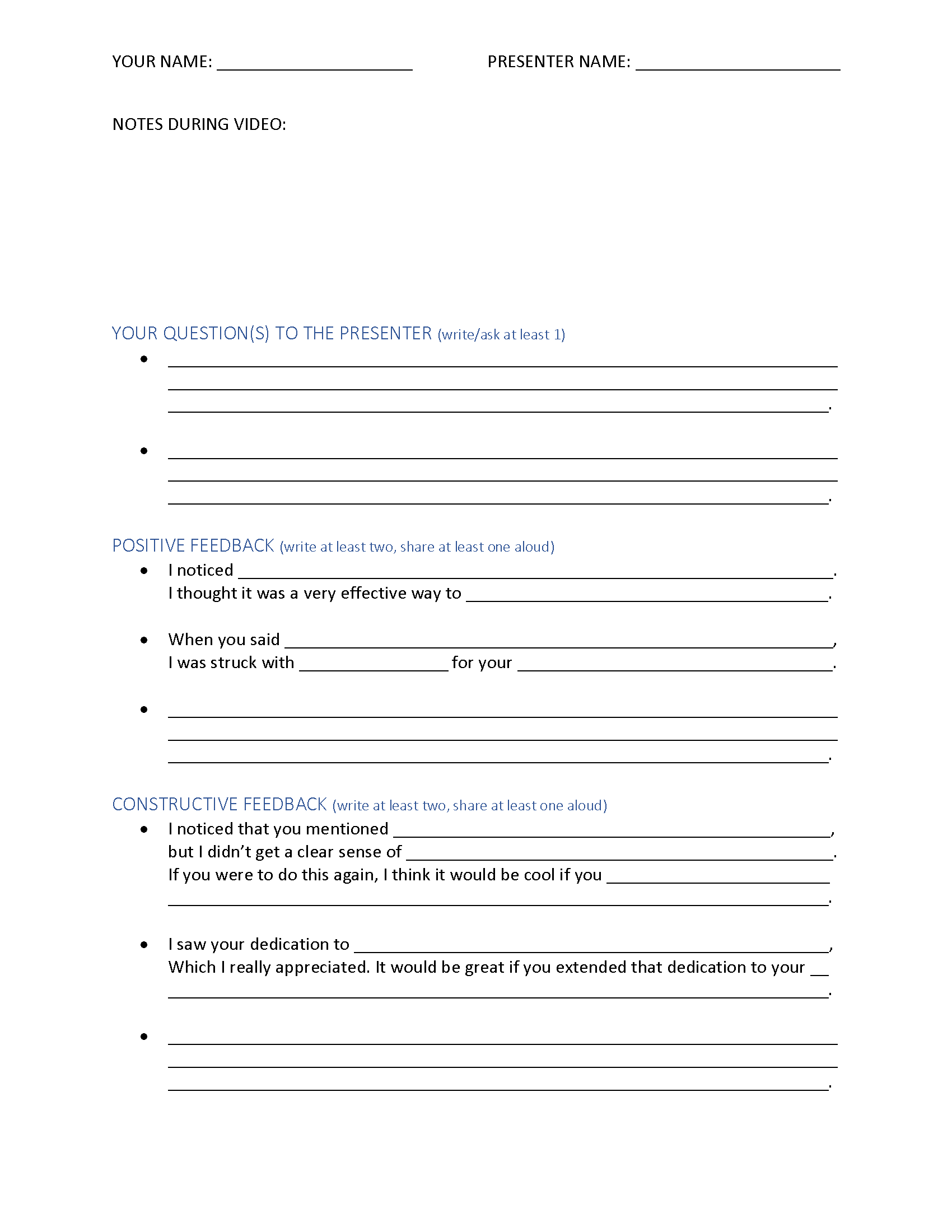
The feedback assignment assessed the following objectives:
-
Vulnerability Initiate strategies for gracefully engaging in vulnerable conversations and exercises. (E-S-N-U)
-
Effortful Engagement Effortfully engage in course learning opportunities. (Effortful Engagement)
Though we only scheduled one class day for the presentation and oral feedback, we allowed students a two-week period to resubmit both their videos and the feedback worksheet to improve their initial assessments. The last time we taught the course, about half of the students chose to resubmit one or both of the assessments.
TL;DR for the rewrite:
- We told students why they were doing the assignment (to analyze their leadership style through a different lens).
- We allowed students to present their videos to one another, thus facilitating connection instead of judgement.
- We allowed the students to actively practice the feedback skills we taught them, instead of just talking about the skills theoretically.
- We were more clear about the objectives we were hoping students would meet (though we could still improve some in that area).
- We broke up the original homework assignment into two pieces - a small project (the video or presentation) and an assessed in-class activity (the feedback).
- We adjusted the assignment so both components could be resubmitted to show growth.
Homework Resubmission Policies
Policies regarding homework resubmission vary widely across mastery grading classrooms. Some classrooms limit the number of resubmissions (no more than X resubmissions) or limit the time to resubmit (no more than X days to resubmit). Some classrooms don't set any limits at all.
Personally, we choose a 28-day limit. Students can resubmit their work as many times as they like within a 28 day window (which begins at the assignment's due date). Four weeks (28 days) just long enough to give students time to recover from sickness, fly home for funerals, etc., while still short enough to ensure students are focusing on the present. A typical student in our courses resubmits a typical assignment about 80% of the time. However, the resubmissions are usually focused and targeted, and thus very quick for us to reassess. Very few students resubmit assignments more than once.
Regardless of your time/quantity limitations, there is one policy that we recommend with relation to resubmissions. It is beneficial for students to reflect on the feedback you've provided as they prepare their work for resubmission. For every objective that a student asks us to reassess, we require them to write a short (usually 1-2 sentence) reflection on what they changed and how that change addresses our feedback. This guides the student toward making only necessary changes while also giving us a roadmap for reassessment.
Looking Forward
You're still here and we're still grateful for the time you're taking to make your courses more equitable. Look at you go!
In the next section, we discuss one more type of assessment (Participation Assessments), before digging into tips and tricks for the assessment process.
Footnotes
-
We'd love to give a ton of helpful feedback on all of our students' work, but we promised that we'd be real with you. We just don't have time to go into precise detail on every single artifact that students produce. For us, the Effortful Engagement scale (Complete/Incomplete) is enough for smaller assignments. We can assess whether students effortfully engaged with a glance and whether students are progressing in their learning with a skim. This meets everyone's minimum needs for formative assessment (students need to learn by doing and instructors need to gauge/provide general feedback on how student learning is progressing). It's not ideal, but allows us to focus on the assessment opportunities with the most impact. ↩
-
This example is real and thus perfectly imperfect. We're not holding it up as a work of art to be revered and replicated. We just want to show what mastery grading looks like in the wild. Please keep your growth mindset in mind and extend us a few moments' grace as you read the next few sections. ↩
-
For various reasons, there is no age-based diversity in the cohort of students. ↩