Choosing Mastery Levels & Schemes
In this section, we'll help you build a framework for how you'll assess student work for mastery of the course objectives. But first, we need to clarify a few points. (Get it?! Points, like assessment points?).
Consider the following rubric (from K. Klein, 2015):
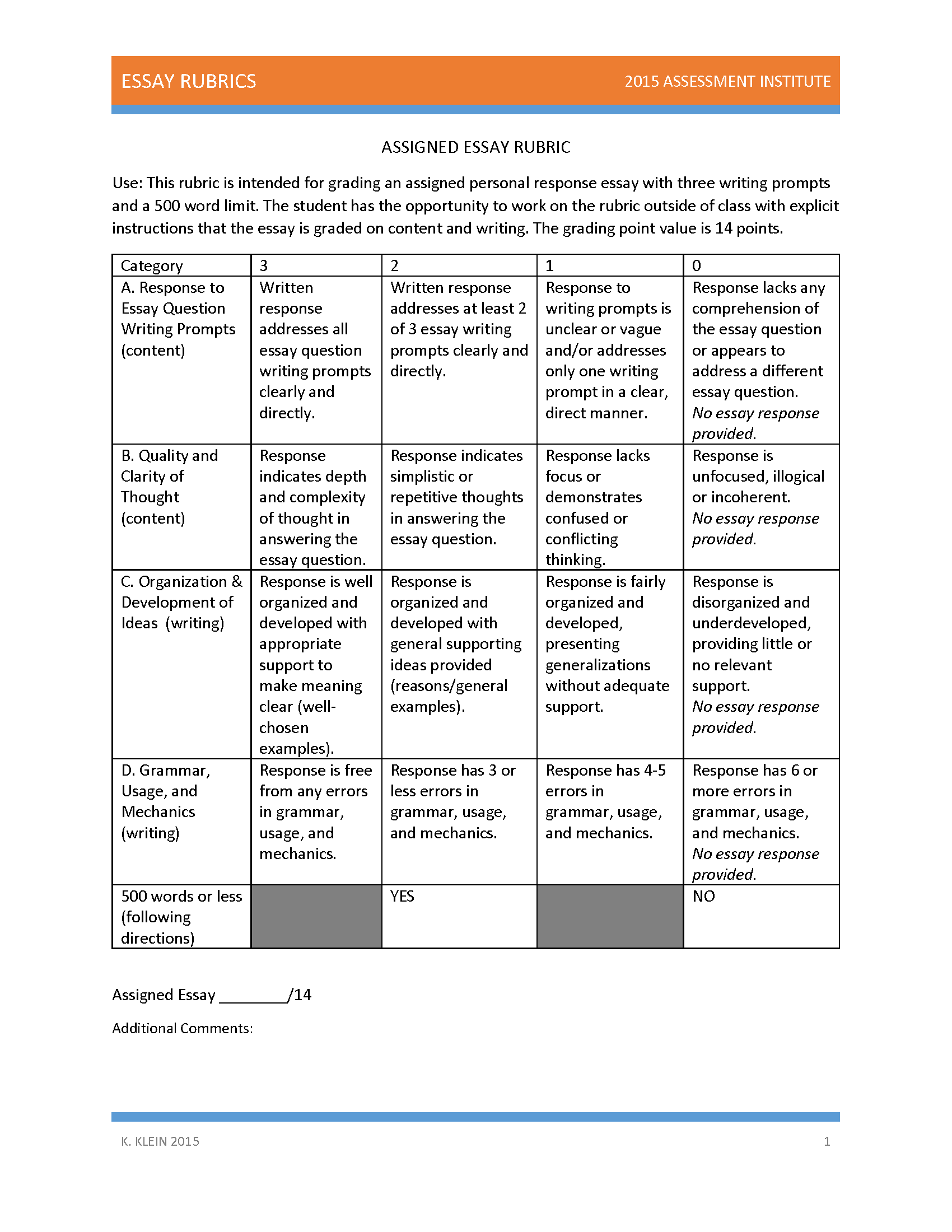
We have a lot of issues with this rubric (from the fixed-mindset, punishment terminology to the point-based gradient), but, nevertheless, it is fairly standard for a traditionally graded course. Each row in the rubric's grid represents some criterion for assessment, and each column represents how many points a student's work is worth across the performance gradient, which in this case is 4 points for "appropriate" work and 0 points for "underdeveloped" work.1
In mastery grading, the rows ("criteria") for an assessment opportunity are drawn from the set of objectives you wrote in the last step. Each column (each step in the "performance gradient") is a mastery level.
What is a "Mastery Level"?
A mastery level is a single, discrete category of assessment -- a single column of a mastery grading rubric. Usually, mastery levels are given a name, like "Satisfactory" or "Not Yet," and a generic description of what that mastery level means in the context of a particular course.
Mastery levels are defined generically because they are used to describe mastery of whole categories of objectives. For example:
Satisfactory The work shows evidence of conceptual understanding and can benefit from additional application or polish.
Notice that the description of the mastery level focuses on evidence in the work, not on the attributes of the student. Additionally, notice the growth-oriented word choice:
- "and" (instead of "but"), and
- "can benefit from additional application or polish" (instead of "is unpolished and lacks any comprehension").
The description should focus on what the work is and can grow to be, not about what the work isn't.
What is a "Mastery Level Scheme"?
If a mastery level is a single column in the rubric, a mastery level scheme is the set of all columns in the rubric. A mastery level scheme is an ordered list of two or more mastery levels that collectively represent the "performance gradient" used to assess student work.
How many mastery levels should I have in my scheme?
Generally speaking, you need to have at least two mastery levels in a mastery level scheme, but the upper bound is up to you. We've found that there's a sweet spot somewhere around 4 or 5. Any more than that and we struggle to differentiate between the levels, and the students struggle to understand how their grade distinctions (e.g., A, B, C, etc) are calculated. What makes sense for your objectives?
Sample Mastery Level Schemes
A sample two-level scheme might look like:
- Complete Work completed with effort, intention, and conceptual understanding.
- Incomplete Work not finished or as yet unattempted.
A three-level scheme might look like:
- Satisfactory Work shows evidence of conceptual mastery and effortful engagement.
- Not Yet Work shows evidence of growing conceptual understanding and could benefit from additional application or polish.
- Unassessable Work does not yet provide enough evidence to assess mastery.
A four-level scheme might include:
- Exemplary Work shows evidence of mastery with exceptional attention to detail.
- Satisfactory Work shows evidence of conceptual mastery and can benefit from additional application or polish.
- Not Yet Work shows evidence of growing conceptual understanding, which can be strengthened by further practice.
- Unassessable Work does not yet provide enough evidence to assess mastery.
A five-level scheme might include:
- Exemplary Work shows evidence of mastery with exceptional attention to detail.
- Satisfactory Work shows evidence of conceptual mastery and can benefit from additional application or polish.
- On Track Work shows evidence of growing conceptual understanding, which can be strengthened by further practice.
- Early Stages Work shows evidence of effortful engagement with early-stage conceptual understanding.
- Unassessable Work does not yet provide enough evidence to assess mastery.
In practice, we've found that it's helpful to add one additional mastery level to every scheme:
- Excused Work is not required to provide evidence of mastery for this objective.
This mastery level can come in handy in a variety of scenarios, like offering extra credit (those who do not attempt the extra credit are "excused") and providing flexibility for in-class participation in case of emergency.
How many mastery level schemes should I have?
For the sake of your students, we suggest using only one or two mastery level schemes. More than two will be very confusing to your students.
Through our experimentation with our own courses, we have found that two schemes suit our students/objectives best:
- a four-level scheme (Exemplary, Satisfactory, Not Yet, and Unassessable) for Course Topics and Quality objectives, and
- a two-level scheme (Complete, Incomplete) for Effortful Engagement objectives.
Once you've chosen the schemes that work best for your course/students/objectives, take a moment to celebrate your growth. Converting a course from traditional to mastery grading is a mental gymnastics routine of epic proportions.
Looking Forward
If you need to stretch your legs or refresh your favorite hot beverage, do so now. The next step in the process, Converting from Mastery to Letter Grades, will be here when you're ready.
Footnotes
-
If you haven't already read our points-are-insidious manifesto, we encourage you to read it before moving forward. We have strong feelings about "underdeveloped" work being "worth" nothing. It is the student's job to learn, not to be perfect immediately. Their learning has worth. We're not trying to convince anyone to give out "participation trophies" for effort. We are advocating for giving students opportunities instead of "nothing." ↩